
Ethena’s Delta-Neutral Basis Trade
Unlocking sUSDe Yield Mechanics
- In the historical development of decentralized financial infrastructure, the pursuit of a scalable, crypto-native dollar asset has been a primary objective for protocol engineers. Traditional stablecoins like Tether (USDT) and USD Coin (USDC) successfully resolved the volatility problem by anchoring their value to real-world assets, such as short-term United States Treasury bills and fiat currency reserves held within centralized banking institutions. While highly liquid, this design introduces a fundamental systemic paradox: it tethers the decentralized economy directly to the regulatory vulnerabilities and macroeconomic policies of legacy banking systems.
- Alternative attempts to build decentralized stablecoin trade historically gravitated toward overcollateralization or purely algorithmic mechanisms. Overcollateralized assets require users to lock up significantly more capital than they borrow, severely limiting capital efficiency and preventing widespread scaling. Algorithmic assets, which relied on dynamic supply expansion and contraction loops backed by volatile sister tokens, suffered catastrophic game-theoretic failures during major market corrections.
- Ethena alters this paradigm by introducing USDe, a synthetic dollar asset whose stability and yield are driven entirely by a cryptographic Delta-Neutral Basis Trade. By combining liquid staked crypto assets with corresponding short perpetual futures positions across institutional derivatives exchanges, Ethena creates a dollar-pegged instrument that bypasses traditional banking dependence while remaining highly capital-efficient. This deep-dive analysis deconstructs the structural plumbing, custody mechanics, and economic risks of this modern internet bond architecture.

1. The Core Architecture: The Basis Trade Explained
- To evaluate Ethena's financial engineering with institutional rigor, you must first master the concept of directional risk management, colloquially defined as "Delta." In options and derivatives trading, Delta represents the sensitivity of an asset's derivative contract price to changes in the underlying spot price.
- A spot asset, such as Ethereum held in a cold wallet, possesses a positive Delta of one. If the market price of Ethereum rises or falls by a certain percentage, the value of that spot position fluctuates in a direct, unhedged one-to-one ratio. Conversely, a short derivatives contract (such as a short perpetual futures position) possesses a negative Delta of one. If the underlying price decreases, the short contract gains an equivalent amount of value; if the price increases, the short contract loses value in equal proportion.
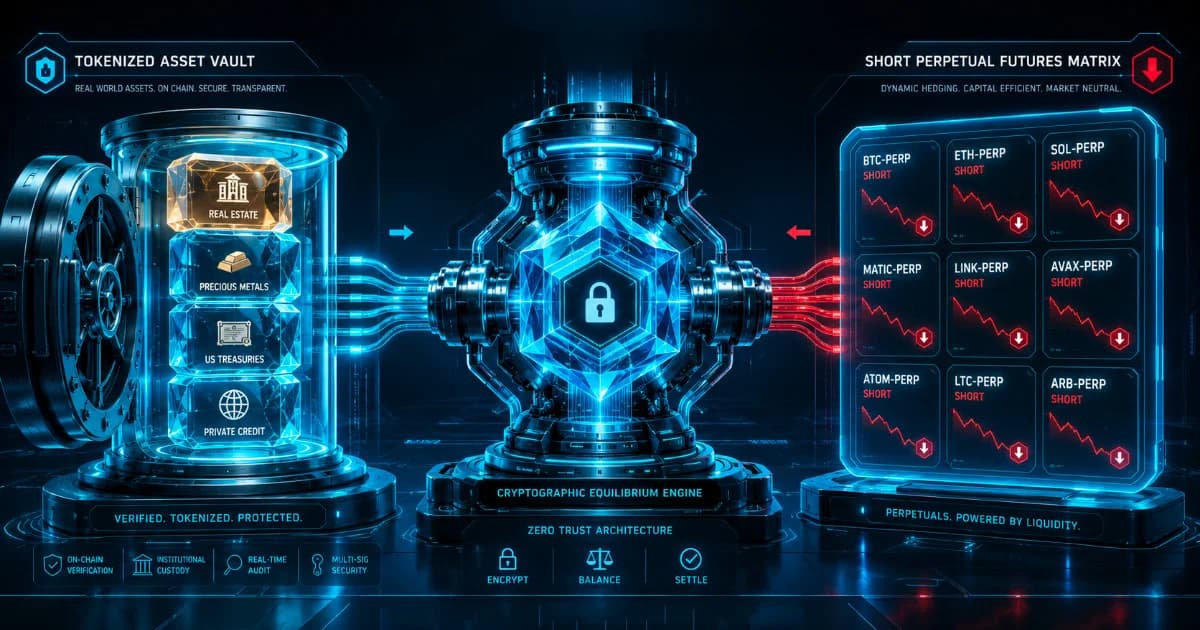
- A Delta-Neutral Basis Trade occurs when an allocator pairs a positive Delta asset with an identical, offsetting negative Delta position. By purchasing one million dollars worth of spot liquid-staked Ethereum and simultaneously opening a one million dollar short perpetual futures contract on an exchange, the net Delta of the entire combined position becomes exactly zero.
- Because the directional exposure is completely neutralized, the total capital value of the basket remains perfectly stable at one million dollars, regardless of whether Ethereum trades into extreme multi-year highs or capitulates into macroeconomic lows. The system has successfully decoupled the capital's dollar value from the underlying asset's price volatility, laying the foundation for a scalable, crypto-native synthetic dollar.
2. The USDe Creation and Collateralization Pipeline
- The minting of USDe is not an algorithmic simulation; it is an active settlement loop that coordinates with institutional custodians and global derivatives venues. The entire pipeline is designed to mitigate exchange counterparty risk, which has historically been a point of failure for crypto-native financial applications.
- The process initiates when a user or Authorized Participant (AP) interfaces with the protocol to deposit a supported collateral asset, such as Lido's liquid staked Ethereum (stETH) or native stablecoins. The protocol does not store this collateral inside a standard, vulnerable protocol smart contract, nor does it deposit the raw assets directly onto the internal balance sheets of centralized derivatives exchanges. Instead, Ethena utilizes an institutional infrastructure framework known as Off-Exchange Settlement (OES).
- The deposited assets are immediately routed to independent, regulated banking custodians and specialized digital asset repositories, such as Copper, Fireblocks, or Ceffu. These OES providers hold the collateral in trust inside segregated, bankruptcy-remote accounts.
- Once the OES custodian confirms the custody of the spot assets, the platform projects this collateral balance to various centralized derivatives exchanges (such as Binance, Bybit, and OKX) via institutional clearing networks. This projection grants Ethena's trading engine the margin credit required to immediately open an equivalent short perpetual futures position on the exchange.
- Because the raw collateral remains safely secured inside the independent custodian's vault, the protocol is shielded from direct exchange insolvency risk. If an exchange platform suffers a sudden operational failure or liquidity event, Ethena's underlying backing capital remains completely isolated inside the off-exchange settlement infrastructure.
3. sUSDe Yield Mechanics: Sourcing the Internet Bond
- The unique value proposition of Ethena's ecosystem is its ability to generate organic, sustainable yield from its backing collateral. When users choose to lock up their liquid USDe tokens inside the protocol's primary staking vault, they receive sUSDe (staked USDe) in return. This asset acts as a yield-bearing instrument that accumulates value over time by capturing revenue from two independent, native crypto-economic streams.
- The first revenue stream is derived from the Spot Collateral Yield. Because the protocol prioritizes liquid staked assets like stETH as its primary collateral backing, the underlying spot assets are continuously earning native validation rewards from the Ethereum consensus layer. This baseline staking yield provides a reliable, non-dilutive interest rate that flows directly into the protocol's treasury.
- The second, and often more explosive, revenue stream is generated by capturing the Perpetual Futures Funding Rate via the protocol's ongoing Delta-Neutral Basis Trade. In crypto-native derivatives markets, perpetual futures contracts do not have a fixed expiration date. To ensure that the price of the perpetual contract stays tightly anchored to the actual spot market price, exchanges implement a continuous balancing mechanism known as the funding rate fee.
- In typical market environments, there is a structural, long-term premium or long-bias across crypto markets. Speculative participants want to utilize leverage to buy assets, which requires them to open long perpetual contracts. To maintain these positions, long traders must continuously pay a recurring funding fee to the participants holding the opposing short contracts.
- Because Ethena's core architecture mandates a permanent, massive short position to maintain its delta-neutral state, the protocol sits as a structural recipient of these funding fees. During expansionary market phases or bull cycles, these funding rates can climb to extreme annualized levels, creating an immense revenue stream that is combined with the spot staking yield and distributed directly to sUSDe holders.
4. Systemic Risks: Dissecting the Fault Lines
An institutional-grade evaluation of any yield-bearing protocol requires a deep exploration of its potential failure points. Ethena's architecture is a sophisticated exercise in risk transference; it eliminates traditional fiat-banking risks but replaces them with a complex web of crypto-native structural vulnerabilities.
The Funding Reversal Threat (Negative Funding)
- The primary economic risk to the sUSDe yield model is Funding Reversal Risk. While crypto markets exhibit a long-term long-bias, extended bear markets or severe deleveraging events can push funding rates into deeply negative territory. In a negative funding regime, short position holders are forced to pay fees directly to long position holders.
- If the negative funding rate completely eclipses the native staking yield generated by the spot stETH, the net yield of the protocol transforms into a structural expense. To protect the core collateral backing of USDe from being slowly eroded during prolonged negative funding periods, Ethena maintains a dedicated Reserve Fund. This fund is an independent capital pool designed to step in and underwrite the negative funding expenses, buying time for the market regime to normalize or for the protocol to gracefully unwind its positions.
The Liquid Staking De-Peg and Execution Friction
- A secondary vulnerability lies in the relationship between the spot collateral and the short derivatives contracts. If the liquid staked asset used as collateral (such as stETH) experiences a severe liquidity de-peg relative to native Ethereum, a major tracking error materializes.
- While Ethena's derivatives contracts short native Ethereum, its collateral is stETH. If stETH trades at a steep discount on secondary markets, the protocol's real-time solvency ratio can face intense pressure. Symmetrically, if the protocol is forced to rapidly execute large-scale redemptions during a period of extreme market panic, execution slippage or exchange trading bans could prevent the automated trading engine from closing out the short positions in perfect synchronization with the spot unwinding, leading to unexpected capital losses.
5. Tracking Market Microstructure via DEXTools
- Navigating a highly reflexive, yield-generating synthetic dollar asset requires real-time validation of its secondary market liquidity pools. While the protocol's internal dashboards display theoretical collateralization ratios, tracking the live on-chain volume dynamics of USDe and sUSDe across decentralized exchanges is the only way to audit genuine market health.
- DEXTools provides the critical analytical infrastructure needed to monitor these metrics, giving participants the ability to monitor pool depth, track automated market maker reserves, trace large whale wallet redemptions, and scan for unusual smart contract activity across alternative blockchains. By utilizing these live diagnostics, allocators can verify if the protocol's scaling velocity matches actual secondary market depth, ensuring their positions remain fully liquid and insulated from unexpected liquidity anomalies.
6. Conclusion: The Paradigm Shift of the Internet Bond
- Ethena's architecture represents a major step forward in the evolution of decentralized monetary design. By transforming the classic Delta-Neutral Basis Trade from a specialized hedge fund strategy into a globalized, permissionless utility token, the protocol has established a scalable synthetic dollar that operates independently of legacy financial clearing networks.
- The resulting sUSDe token acts as a modern crypto-native internet bond, offering an organic revenue stream derived from real-world validation rewards and derivatives market demand. While the system demands constant vigilance regarding negative funding regimes and custody constraints, its ability to capture structural market premiums ensures that Ethena will remain a cornerstone primitive within the modern global digital asset landscape.
Disclaimer: This article is for informational purposes only and does not constitute investment advice, financial advice, trading advice, or any other kind of advice. DEXTools does not recommend buying, selling, or holding any cryptocurrency or token. Users should conduct their own research and consult with a qualified financial advisor before making any investment decisions. Cryptocurrency investments are volatile and high-risk. DEXTools is not responsible for any losses incurred.