Liquidity Pull vs Slow Rug: On-Chain Warning Signs (2026)
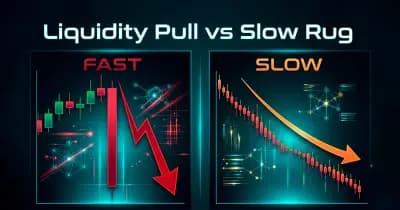
Every memecoin trader eventually meets the same monster wearing two masks. One day it strikes in a single block, draining the pool and leaving holders staring at a vertical red candle. Other days it works in slow motion, bleeding the chart over weeks while the team keeps tweeting roadmap milestones. Both endings look the same in your wallet, but the on-chain footprints leading up to them could not be more different.
This guide draws a hard line between the two most common rug variants in 2026: the instant liquidity pull (hard rug) and the slow rug (soft rug or slow drain). You will learn the mechanics of each, the precise on-chain signals that fire before the exit, the tools that surface those signals in real time, and the playbook for reacting when one of your bags flashes red. Most retail guides describe rugs as a single phenomenon. That is wrong. A liquidity pull is a security failure you prevent with pre-launch screening. A slow rug is a behavioral pattern you only catch with continuous monitoring. Different problem, different defense.

The Rug Taxonomy: Three Families, One Outcome
Crypto exit scams sort into three structural families. Confusing them leads to false security: a project that passes one filter can still die from another.
The hard rug, or liquidity pull, is a one-shot extraction where the LP token holder yanks the entire pool in a single transaction. The token still exists, but buyers cannot sell because the AMM curve is gone. The soft rug, or slow drain, is a multi-week extraction where the team gradually sells supply, removes liquidity in small slices, or uses sneaky tokenomics like stealth taxes to siphon value. The chart often looks normal until the floor caves. The honeypot is a contract rigged so buyers can purchase but cannot sell. The team accumulates from one-way trades, then pulls or abandons. Honeypots are detectable pre-trade with simulation tools. This guide focuses on the first two.
One transaction. Pool drained instantly. Price drops 99 percent in a single block. Caused by missing or weak liquidity locks.
Gradual extraction over 30 to 90 days. Dev sells in slices, removes liquidity in fractions, hides behind fake activity. Behavioral, not technical.
Contract blocks selling. Only buys allowed. Liquidity accumulates from one-way flow then gets pulled or abandoned. Pre-trade detectable.
What is a Liquidity Pull?
A liquidity pull is a hard rug in which the holder of an AMM pool's LP tokens redeems them and withdraws the underlying assets in a single transaction. The token contract is usually untouched, but the trading pair is now empty, so the token is unsellable at any meaningful price. It remains the most common cause of total losses for memecoin traders.
The mechanism rests on how AMMs like Uniswap V4, PancakeSwap, or Raydium work. When a deployer creates a pool, they deposit a base asset (ETH, SOL, BNB) and the new token, receiving LP tokens that represent pool ownership. Whoever holds the LP tokens can burn them to reclaim the underlying assets. If the LP tokens are not locked, burned, or held in a multisig, the deployer can rug whenever they choose.
Liquidity Pull Mechanics, Step by Step
The full lifecycle of a liquidity pull rarely takes longer than three weeks from launch to exit. Understanding the exact sequence makes the warning signals impossible to miss.
Lock Bypass Techniques
Smart traders look for locks before buying, but locks are not bulletproof. Three bypass techniques turn a "safe" sticker into theater. First, early unlock: many lock services let the deployer set duration at creation, so a 30-day lock is just a 30-day countdown. Always read the lock end date, not the badge. Second, LP transfer: some lock contracts let the original locker transfer the locked position to a new address that waits and pulls. Third, partial lock: team locks 30 percent and keeps 70 percent unlocked as the exit fund.
Beyond these, watch for custom lockers. A real lock means the LP tokens live in a verified, immutable contract from a known provider (Unicrypt, Team Finance, PinkLock, Streamflow on Solana). A "lock" enforced by a random contract written by the same team is not a lock. It is a costume.
What is a Slow Rug?
A slow rug is a multi-week to multi-month extraction where the team drains value gradually, using behavioral camouflage to avoid the panic that follows a single-block rug. There is no defining transaction. Instead there is a pattern: persistent dev sells, slow liquidity removal, fake buys to mask real distribution, and a coordinated drift away from the project until the chart collapses.
Slow rugs became the dominant exit model during the 2024 to 2026 Solana cycle, when pump.fun made deployment trivial and lock infrastructure became standard. Teams realized one-block rugs leave a clear paper trail and attract outrage. A drawn-out drain produces the same financial result with far less heat. By the time holders notice, the team has cycled wallets, mixed funds, and rebranded under a new ticker.
Slow Rug Mechanics
The slow rug playbook depends on four mechanisms in parallel: gradual dev selling, fake activity to hide distribution, rotating wallets, and a 30 to 90 day timeline that exhausts attention.
Gradual dev selling is the engine. Instead of dumping in one block, the team sells in slices of 0.5 to 2 percent of float per day. Each sell looks like a whale taking profit. Aggregated over 60 days, the wallet has unloaded its full bag. The classic tell is sells that consistently spike on green wicks, sustained over weeks. Fake activity is the camouflage. Wash buy bots cycle the token between wallets, inflating 24-hour volume, hiding dev sells inside chart noise, and keeping the token in trending lists. Rotating wallets is the cleanup. Funds move from dev wallet to fresh wallet, then to a mixer (Tornado Cash, Railgun, weak-AML bridges), then to cold storage. The original wallet looks idle. The new wallets have no obvious link.

Side by Side: Instant vs Slow Rug Signals
This is the table that should live in every trader's notes. Match the patterns you observe to the column they belong in, then act accordingly. A token can exhibit signals from both columns at once. In that case, exit first and analyze later.
| Signal Category | Liquidity Pull (Instant) | Slow Rug (Drain) |
|---|---|---|
| Lock Status | Lock end date approaching, partial lock, custom locker | Lock often valid, but team holds large unlocked supply |
| LP Token Movement | Large LP transfers to fresh wallet hours before pull | LP mostly static, small partial removals every few days |
| Dev Wallet Behavior | Sudden routing to mixers, idle then active spike | Consistent low-volume sells, wallet rotation, mixer drips |
| Social Signals | Sudden silence, admins muted, marketing budget cut | Team distances over weeks, fewer AMAs, generic posts |
| Volume Pattern | Normal until the pull block, then zero | Suspicious wash buys, sell pressure spikes on pumps |
| Roadmap Behavior | Often unaffected: rug happens before milestone | Promises buybacks, no buybacks happen on chain |
| Holder Distribution | Concentrated, often 1 wallet over 30 percent | Slowly concentrates as small holders quit |
| Time to Zero | Seconds to minutes | 30 to 90 days, sometimes longer |
| Detection Window | Hours before pull, sometimes days | Continuous, observable from day 7 to 14 |
Key Signals for an Imminent Liquidity Pull
If you can identify any three of the following signals on a token you hold, exit immediately. None of these are theoretical. They are the actual on-chain footprints that precede the overwhelming majority of pulls in 2026.
LP Lock End Date Approaching
The highest-value signal is a lock expiry inside the next 14 days. Pull the lock contract on the provider's dashboard (Unicrypt, Team Finance, PinkLock). It has a precise end timestamp. If that date is approaching and no relock is announced with longer duration, treat the token as a countdown clock.
Large LP Token Transfers
Pre-rug positioning almost always includes a transfer of LP tokens from the deployer to a fresh, unfunded wallet, so the rug comes from an address with no public team link. Detect this on the LP token's Transfer events on Etherscan or Solscan. Filter for full-balance movements to a brand-new address.
Dev Wallet Routing to Mixers
Watch the deployer wallet for outflows to known mixer addresses: Tornado Cash routers and Railgun on EVM, cross-chain bridges to weak-KYC chains on Solana. Etherscan wallet labels and Bubblemaps already tag many mixer entry points. If you see the dev moving size to a mixer, the rug is in motion.
Social Account Activity Drop
Track the cadence of posts on Twitter, Telegram, and Discord. A team that posted 20 times a week for a month and suddenly drops to 3 is rebalancing attention away from the project. Combine with LP signals for confirmation.
Marketing Budget Cuts
Many projects publish a marketing wallet on chain. Outflows to KOLs, ad networks, and giveaway distributions follow a rhythm. When those outflows stop, marketing is frozen. A team that stopped paying for attention is a team that no longer needs new buyers.
Key Signals for an Ongoing Slow Rug
Slow rugs need continuous monitoring, not pre-trade checks. Set up alerts on the wallets and metrics below. If two or more fire simultaneously over a 14-day window, the project is bleeding out.
Consistent Low-Volume Dev Sells
Plot the dev wallet's daily sell volume against price. A healthy team holds during pumps. A slow rug team sells every day, especially on green days, with sells sized just below the whale alert threshold. Look for sells of 0.5 to 2 percent of float, repeated for 20 plus consecutive days.
Large Transfers to Unknown Wallets
Beyond direct sells, slow ruggers transfer tokens to fresh wallets to distribute sell pressure across addresses screeners do not flag. Watch for non-trivial sends (over 1 percent of float) to wallets with no prior funding. If those wallets sell into the pool within 48 hours, that is coordinated distribution.
No Buybacks Despite Roadmap Promises
Slow rug projects often publish roadmaps with "buyback and burn" milestones. The on-chain record rarely matches. Pull the announced buyback wallet and check for actual swap transactions. If the roadmap promises monthly 10k buybacks and the wallet shows zero swaps for three months, the buyback lives only in the marketing deck.
Team Distancing From Social Media
Unlike a pull where social goes silent overnight, slow rugs feature a gradual fade. The founder stops doing AMAs. Posts become templated. The team stops answering tokenomics questions. Track the ratio of replies to original posts: a thriving team replies often, a fading team only broadcasts.
Sell Pressure Spiking on Price Pumps
The textbook slow rug signature. Every time organic buyers push price up 10 to 20 percent, the dev wallet (or one of its rotated cousins) emits a sell into the wick. The pump dies. The chart looks like failed breakouts in series. Verify by overlaying dev outflows on the candle chart. Sells consistently within 30 minutes of green wicks for weeks is your answer.
Wash Buys to Mask Real Distribution
Wash trading hides the slow rug's true sell pressure. Look for paired buys and sells of similar size, seconds apart, between wallets with no other connection. Fake volume detectors automate this. When much of daily volume is wash activity, real organic interest is far lower than the screener suggests.
Detection Tools: Building Your Stack
Identifying rugs by hand is slow. The traders who survive memecoin cycles run a stack of tools that surface the signals automatically. Below is a minimum viable detection stack for 2026. Most of these are free or have a generous free tier.
Solana-focused contract scoring. Flags mint authority, freeze authority, LP burn status, top holder concentration. Use as the first filter.
Visual cluster analysis of token holders. Reveals supply concentration disguised across many wallets. Essential for spotting slow rug wallet rotation.
Live transaction stream, liquidity history, holder list, DEXTscore. Single screen for monitoring active positions. Filter by transaction size to surface whale moves.
Authoritative event log for EVM chains. Use the wallet labeling features and the LP token Transfer event filter to track positioning moves.
Solana equivalent. Whale watch view and token authority panel are the must-use screens. Cross-reference with Bubblemaps for cluster context.
Tools like transaction simulation services preview the outcome of a swap. Best honeypot detection layer. Run before every memecoin entry.
DEXTools Liquidity Tracking in Depth
DEXTools surfaces both pull and drain signals on one screen. Open any pair, find the liquidity chart, drag to maximum history. A healthy memecoin shows a step function: liquidity grows at launch, plateaus, and stays flat or grows further. A liquidity pull shows a vertical drop from plateau to zero. A slow rug shows a stair-step decline: small downward steps every few days, totaling 30 to 70 percent over a month.
Combine the liquidity chart with the holder list and the live transaction stream. If the top wallet's balance is shrinking while liquidity steps down, the same actor is selling and draining. That is a slow rug in progress. Confirm by checking recipient addresses against Bubblemaps clusters.
Case Studies: Real Rugs, On-Chain Forensics
Theory becomes useful when paired with examples. Below are six real cases, three instant pulls and three slow rugs, spanning 2021 to 2026. Each case includes the dollar size, the headline signal that would have warned a watcher, and the on-chain pattern that confirmed it post-mortem.
Instant Pull: Squid Game Token (November 2021)
Squid launched on PancakeSwap riding the Netflix show's moment. Liquidity climbed to roughly 3.4 million USD within days. The contract had a sell restriction (honeypot mechanism) that prevented holders from exiting. The team extracted approximately 3.38 million USD in a single transaction by burning their LP. The headline signal was the sell restriction, detectable in seconds by any pre-trade simulator.
Instant Pull: AnubisDAO (October 2021)
AnubisDAO raised approximately 60 million USD via a 24-hour Copper Launch LBP. Funds went to a team-controlled multisig. Within hours of the raise closing, all 13,556 ETH were drained to a fresh wallet and routed through mixers. The headline signal was the absence of vesting or time-locks on the raised funds, visible in the multisig configuration before the raise ended.
Instant Pull: Generic Solana Memecoin (2025)
By 2025, dozens of identical pulls happened on Solana daily via pump.fun. Typical script: deployer creates the token, seeds the pool with 30 to 80 SOL, holds 15 to 25 percent of supply, waits for an organic pump to grow the pool to 50k USD, then sells the entire team allocation while routing LP proceeds to a fresh wallet. Elapsed time from launch to pull: often under 6 hours. Detection: dev wallet supply percentage on day one (over 10 percent is a red flag) and any team allocation not frozen via Streamflow.
Slow Rug: Solana Cohort, Q3 2024 to Q1 2026
The largest slow rug cohort in crypto history played out across Solana from late 2024 through early 2026, with tens of thousands of tokens slow-rugged and hundreds of millions in aggregate losses. The pattern was uniform: dev teams retained 15 to 30 percent of supply, locked the LP for 90 days via Streamflow, then sold their bag in 0.5 to 1 percent daily slices through the lock period. When the lock expired, the LP was already shrunken. The final pull was an afterthought. Any trader tracking dev sells for the first 14 days after launch would have seen the pattern. The combo of Bubblemaps cluster analysis and DEXTools wallet tracking made these visible from week one.
Slow Rug: BSC Yield Farm Era (2021 to 2022)
BSC yield farms pioneered the slow rug model. Projects offered absurd APYs (500 percent to 10,000 percent), attracted deposits, and drained pools over weeks by minting reward tokens the team dumped on the open market. The headline signal was the unsustainable inflation schedule. On-chain confirmation was steady outflow from the rewards minting contract to the team multisig, then to CEXs.
Slow Rug: Influencer Coin Pattern (2024 to 2026)
An influencer-launched coin subgenre emerged with a stable pattern: a personality launches a coin, claims long-term hold, and quietly sells through OTC or wallets they pretend not to control. The signal was usually a cluster of wallets receiving equal team allocation slices on day one, then selling in coordinated waves over 60 days. Bubblemaps surfaced these within hours.

How to React When Signals Fire
Spotting a signal is half the work. The other half is acting without freezing. Below is the tiered playbook based on signal strength.
Immediate Full Exit
Exit everything immediately on any of: LP token transfer to fresh wallet, dev outflow to mixer, lock end inside 72 hours with no relock, or sudden hour-over-hour pool drop over 15 percent. These are not recoverable. Once they fire you are racing other holders to exit before the actual pull. Market order, accept slippage, move on.
Partial Exit, Tight Stop
Cut position by 50 to 70 percent and set a tight stop on the rest if two or more fire: consistent daily dev sells, social drop, marketing wallet inactivity, sell spikes on green wicks, stair-step liquidity decline. Slow rug in progress. Partial exit limits damage. Remainder lets you ride if the team reverses course.
Watch Only, Set Alerts
One weak signal: do not exit, but enable alerts on the deployer wallet, LP contract, and pool. DeBank, Nansen, or Etherscan email notifications work. If a second signal fires, escalate to partial. If a third fires, full exit.
Pre-Launch Screening Checklist
The cheapest defense is filtering tokens before you enter. A token that fails any of the following checks is not a buy. Use this list as a gate. The 60 seconds it takes to run through will save you from the majority of pulls.
- Contract verified on Etherscan, Solscan, or BscScan. Unverified contract is an automatic no.
- Mint authority renounced or burned. For Solana, check via RugCheck. For EVM, read the contract owner function.
- Liquidity locked through a verified third-party locker for at least 90 days, ideally 180 plus.
- At least 80 percent of LP locked. Partial locks below this are unsafe.
- Top 10 holders, excluding the LP and CEX wallets, hold under 30 percent combined.
- Bubblemaps cluster view shows no hidden concentration across multiple wallets.
- Audit by a recognized firm (CertiK, Hacken, Trail of Bits) for non-meme projects. Audit weight is lower for memes but team transparency matters more.
- Dev reputation: prior projects under the same wallet or identity. Anon devs are tolerable for memes, dangerous for utility tokens.
- Honeypot simulation passes: a test buy and immediate test sell completes successfully on a small amount.
- Tax structure under 5 percent on both buy and sell. Tax over 10 percent is a slow rug accelerator.
Recovery Options After a Rug
Recovery from a rug pull is rare. The infrastructure of crypto, by design, makes irreversible transactions impossible to claw back without consent. But there are a handful of paths that occasionally produce results, and it costs nothing to attempt them.
First, file a report with the chain's law enforcement liaison if one exists. The FBI's IC3, Europol, and various national cybercrime units accept crypto fraud reports. Documentation matters: provide the contract address, the rug transaction hash, your purchase transaction hashes, and any communication with the team. Aggregated reports occasionally lead to wallet freezes when funds touch regulated exchanges.
Second, contact the exchange or stablecoin issuer if the rugger routes funds through their platform. Tether and Circle have frozen stablecoin balances tied to confirmed scams when presented with sufficient evidence. Major centralized exchanges sometimes freeze deposits from blacklisted addresses. The success rate is low but nonzero.
Third, join class action efforts when they form. Several law firms now specialize in crypto fraud recovery and pool victims of large rugs into civil suits. Recovery rates are typically under 10 percent of losses, and the process takes years, but it is something. Avoid "recovery services" that charge upfront fees. Those are universally scams targeting the already-burned.
Best Practices for Active Memecoin Traders
If you actively trade memecoins, the rug risk does not go away. It becomes a cost of doing business. Manage it with the following practices. None of these are optional if you intend to trade beyond a single cycle.
Use a dedicated burner wallet for memecoin trades. Never connect the wallet that holds your long-term bags to a fresh memecoin contract. Approval exploits and contract upgrades can drain wallets months after the initial interaction. Keep your trading wallet funded only with the capital you have allocated to active positions.
Set a maximum position size per memecoin and never violate it. A common rule among professional memecoin traders is 1 to 2 percent of portfolio per position, with a hard cap of 5 percent for high-conviction plays. This sizing absorbs the inevitable rugs without ending your run. Pair this with strict wallet security practices so the rugs you do absorb are limited to the position itself.
Take profit in tranches. Sell 50 percent at 2x, another 25 percent at 5x, and let the remainder ride. Most rugs happen well before the chart hits these targets. The traders who hold for the absolute top are the same traders who give back everything to the rug. Locking in profits at predetermined levels is what separates survivors from victims.
Run continuous monitoring on your active positions using tools like DEXTools alerts, Etherscan watchlists, or dedicated Telegram bots. The slow rug signals only matter if you see them in real time. A check once a week is not enough. Set up push notifications for any LP movement, large dev sell, or social account silence. Treat your active bags like portfolio positions, not lottery tickets.
Pros and Cons of Active Rug Detection
- Most rugs are detectable with simple on-chain checks
- Tools are free or cheap, accessible to any retail trader
- Detection skills transfer across chains and tokens
- Even partial signal detection reduces average loss size
- Sharpens overall trading discipline and risk sizing
- Continuous monitoring is time-intensive at scale
- Some signals produce false positives, costing missed gains
- Sophisticated teams now mask signals more effectively
- Cross-chain wallet tracking remains imperfect
- No guarantee: novel rug patterns emerge regularly
Where Rug Detection Sits in the Broader Trading Stack
Rug detection is one layer of a complete memecoin trading stack. It pairs naturally with other skills: reading order flow, sizing positions correctly, knowing when to take profit, and understanding the mechanics of the chains and DEXs you trade on. The traders who survive memecoin cycles for more than 18 months are not the ones who avoid every rug. They are the ones who size such that the rugs they catch do not end their run.
If you trade on Solana, deepen your understanding of how alternative L1s and Solana itself handle token authorities. Mint and freeze authority are the two biggest pre-rug filters on Solana. Renounced authorities reduce hard rug risk substantially. On EVM chains, focus on contract ownership patterns, proxy upgradability, and the specific behaviors of DEX aggregators that route your trades. Aggregators can mask honeypots by attempting alternate routes, but they cannot save you from a liquidity pull.
Layer in macro awareness. Rug rates spike during memecoin manias and fall during consolidation periods. When sentiment is euphoric, teams launch faster, screen less carefully, and have larger pools to drain. When sentiment is bearish, fewer launches happen but the surviving ones tend to be higher quality. Adjust your screening strictness to the cycle phase. Combine this with technical analysis basics like VWAP and liquidation zones to time your entries and exits more precisely.
Finally, consider how your funding sources affect rug exposure. Trading with stablecoins like USDT on an L2 reduces gas friction and lets you exit positions faster than waiting for ETH gas to clear. Understanding gas fee dynamics helps you front-run the rush when a rug signal fires. The speed of your exit during a real pull is often the difference between losing 20 percent and losing 99 percent.
Frequently Asked Questions
Q Q Q What is the difference between a liquidity pull and a slow rug?
A liquidity pull (hard rug) is a single-transaction extraction where the LP token holder withdraws the entire pool, causing an instant 99 percent crash. A slow rug is a gradual drain executed over 30 to 90 days through repeated small dev sells, partial liquidity removals, and wash buys that hide real distribution. Both produce a total loss, but the on-chain footprints and detection methods are different.
Q Q Q Can a liquidity lock prevent a rug pull?
A real lock prevents the specific scam of withdrawing the locked LP tokens before the lock expires. It does not prevent slow rugs, dev wallet sells, or pulls after the lock expires. Always check the lock end date, the percentage of LP locked, and the lock provider's legitimacy. A 30-day lock is just a 30-day countdown.
Q Q Q How do I detect a slow rug before the chart collapses?
Set alerts on the deployer wallet and the LP token contract. Watch for consistent daily sells from the team wallet, gradual liquidity decline of 1 to 3 percent per week, sell pressure spiking on every price pump, social media drift over weeks, and missing buybacks from announced buyback wallets. Two or more of these firing in the same 14-day window is your exit signal.
Q Q Q Which tools are best for rug detection in 2026?
The minimum viable stack is RugCheck.xyz for Solana contract scoring, Bubblemaps for wallet cluster analysis, DEXTools Pair Explorer for live transaction monitoring, Etherscan or Solscan for raw chain data, and a transaction simulator for honeypot detection. Most of these have free tiers. Pair them with custom alerts on wallets you actively monitor.
Q Q Q Are all memecoins rugs?
No, but a high percentage are. Estimates from on-chain research firms suggest that the majority of memecoins launched on permissionless launchpads in 2024 to 2026 were either rugged or abandoned within 90 days. Survivor memecoins do exist, often with renounced contracts, locked liquidity, and engaged communities. The job of detection is to filter the survivors from the much larger pool of exit scams.
Q Q Q What is a honeypot and how is it different from a rug?
A honeypot is a smart contract designed so buyers can purchase the token but cannot sell. The team accumulates funds from one-way trades. A rug pull is the extraction event itself, where the team withdraws the pool or sells their bag. A honeypot is a specific contract design, while a rug is an action. Honeypots are easier to detect because a test sell of a tiny amount reveals the restriction before you commit real size.
Q Q Q Can I recover funds after a rug pull?
Recovery is rare. Crypto transactions are irreversible by design. Limited options include reporting to law enforcement (FBI IC3, Europol), contacting stablecoin issuers like Tether or Circle to request a freeze on rugger funds, and joining class action suits when they form. Avoid "recovery services" that charge upfront fees. Those are scams targeting the already-burned.
Q Q Q How long does a typical slow rug take to complete?
Typical slow rugs play out over 30 to 90 days. The most common pattern on Solana in 2024 to 2026 used a 90-day liquidity lock as the timeline, with the team selling their bag in daily slices for the entire lock period and then pulling the now-reduced LP when the lock expired. Some patient ruggers stretch the timeline to 6 months or longer to maximize extracted value.
Q Q Q Do audits prevent rugs?
Audits from reputable firms (CertiK, Hacken, Trail of Bits) reduce smart contract exploit risk but do not prevent rugs by themselves. An audit verifies that the contract does what it claims. It does not stop the team from selling their allocation, removing unlocked liquidity, or abandoning the project. Treat audits as one input among many, not a green light to ignore other signals.
Q Q Q What percentage of LP should be locked to be considered safe?
Industry consensus is at least 80 percent of LP tokens locked for a minimum of 6 months, ideally 12 months or more. Locks below 80 percent leave a meaningful unlocked portion the team can pull. Locks below 6 months are short enough that the lock end approaches quickly. Many strong projects burn 100 percent of LP, which is permanent and the gold standard.
Q Q Q How does DEXTools help me spot rug signals?
DEXTools Pair Explorer gives you the liquidity history chart (vertical drops for pulls, stair-step declines for slow rugs), the holder list (track concentration changes), the live transaction stream (catch large dev sells in real time), and DEXTscore (automated risk scoring on contract security). Setting alerts on a pair lets you monitor multiple positions without staring at charts all day.
Q Q Q What should I do if I am holding a token that just showed a rug signal?
Exit immediately if you see hard signals: LP transfer to fresh wallet, dev outflow to mixer, sudden liquidity drop over 15 percent in an hour, or lock end within 72 hours with no relock. Use a market order, accept slippage, and stop watching the chart. For softer signals like consistent daily dev sells, exit 50 to 70 percent of your position and set a tight stop on the remainder. Hesitation costs more than slippage.
Conclusion
Liquidity pulls and slow rugs are not the same problem and they do not have the same solution. Liquidity pulls are a pre-launch screening problem. If you filter for locked liquidity, renounced authorities, and clean holder distribution before you enter, you will avoid the majority of them. The remainder come from lock bypass techniques and post-lock pulls, which you detect by watching the lock end date and the LP token transfers in the days before it.
Slow rugs are a continuous monitoring problem. They unfold over weeks, hide behind fake activity, and depend on holder attention erosion. You catch them by tracking the dev wallet, the liquidity history, and the social cadence in real time. The signals are not subtle once you know what to look for. They just require you to actually look, every day, on every active position.
The traders who survive memecoin cycles for years are not luckier than everyone else. They have built systems that flag rugs early and they execute the exit when the system fires, without arguing with the data. The information is on chain. The tools are free. The discipline is yours. Open DEXTools, check your active positions against the signal table in this guide, and make whatever exits the data demands. That habit is worth more than any single trade you will ever make.
For more on staying safe across the broader DeFi stack, read our guides on decentralized finance, address poisoning scams, and safer token approvals via Permit2. The defense is a stack, not a single trick.
Disclaimer: This article is for informational purposes only and does not constitute investment advice, financial advice, trading advice, or any other kind of advice. DEXTools does not recommend buying, selling, or holding any cryptocurrency or token. Users should conduct their own research and consult with a qualified financial advisor before making any investment decisions. Cryptocurrency investments are volatile and high-risk. DEXTools is not responsible for any losses incurred.