
What Are Token Decimals? Crypto Explained (2026)
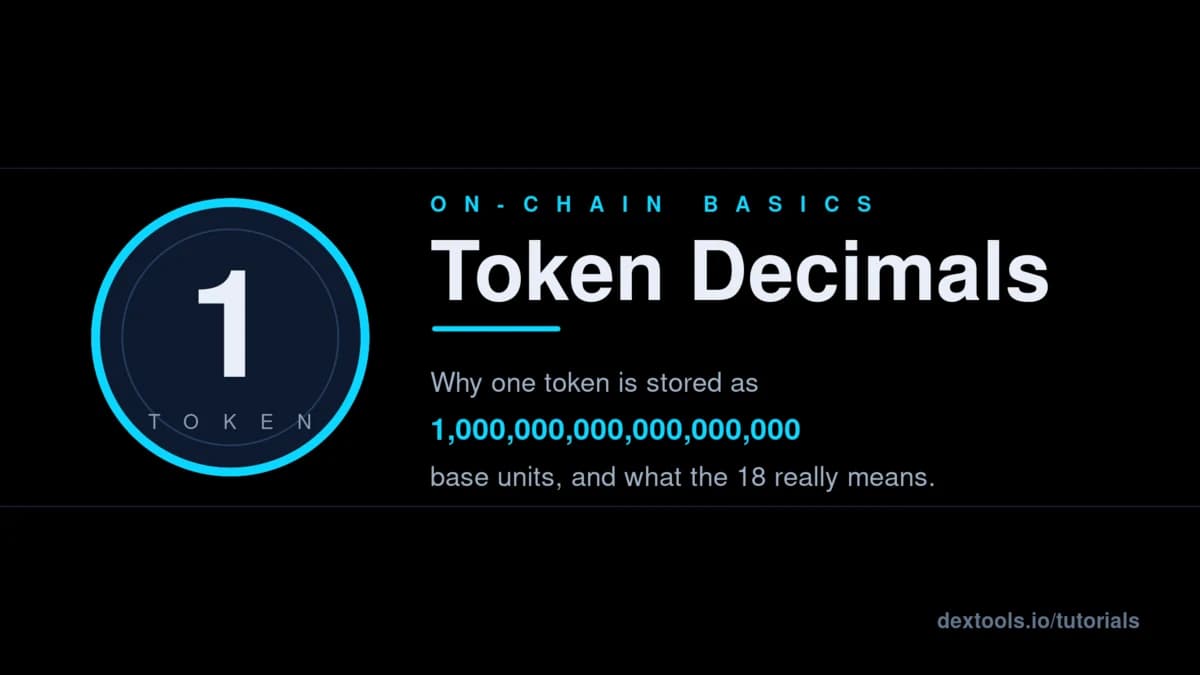
Intent check: This is the plain-English explainer for what token decimals are and why they matter when you read balances, swaps, and contracts. If you want the sister concept of how a trade is priced, read Base Token vs Quote Token.
Token decimals are one of those details that most crypto users never think about until something looks wrong. You send 100 USDC and the explorer shows a transfer of 100000000. You buy a new token and your wallet says you own 4,200,000 of them, yet the position is worth twenty dollars. You import a contract and the balance reads as a number with eighteen zeros hanging off the end. None of this is a bug. It is decimals doing exactly what they are designed to do, and once you understand the mechanism you will read on-chain data with far more confidence.
This guide explains what token decimals are, why Ethereum settled on eighteen of them, how the raw on-chain number differs from the amount your wallet displays, and how an unusual decimals value can be an early warning sign. By the end you will know how to check any token's decimals yourself and why this small number quietly underpins every transfer, swap, and approval you will ever sign.
What Are Token Decimals?
A blockchain cannot store fractions. Smart contracts work only with whole numbers, because integer math is the only kind that stays perfectly consistent across thousands of independent nodes. That creates an obvious problem: money needs cents, and crypto needs the equivalent of cents. The solution is to store every balance as a very large whole number of tiny base units, and then tell wallets and websites how many of those units make up one whole token. That instruction is the token's decimals value.
In the ERC-20 standard, decimals is an optional piece of metadata: a single small number, published by the token contract, that says where to place the decimal point when showing a balance to a human. If a token has 18 decimals, then one whole token equals 1 followed by eighteen zeros in base units. If it has 6 decimals, one whole token equals 1 followed by six zeros. The contract itself never sees a decimal point. It only ever moves integers around. Decimals are purely a display convention layered on top by the software you use.
This is the single most important idea to hold onto: decimals do not change how much a token is worth or how many exist. They only change how the raw number is shown to you. A balance of 1000000 base units on a 6 decimal token and a balance of 1000000000000000000 base units on an 18 decimal token can both display as exactly 1 token.
Why Does Ethereum Use 18 Decimals?
Eighteen decimals is the de facto standard for ERC-20 tokens, and the reason is historical. Ether itself, the native currency of Ethereum, is divisible into a smallest unit called the wei, named after cryptographer Wei Dai. One ether equals exactly 1,000,000,000,000,000,000 wei, which is 10 to the power of 18. When the first ERC-20 tokens were written, developers simply mirrored ether's precision so that token math and ether math would line up cleanly. The convention stuck, and today the overwhelming majority of tokens you meet on Ethereum and EVM chains use 18 decimals by default.
That level of precision sounds excessive, and for everyday amounts it is. But it exists so that contracts handling things like staking rewards, interest, or fractional liquidity shares can divide balances into extremely fine slices without rounding errors piling up. Eighteen decimals gives smart contracts enormous headroom to do math safely.
Not Every Token Uses 18
Here is where people get caught out. The ERC-20 standard does not force any particular decimals value. It is a suggestion, not a rule, and several of the most widely held tokens in crypto deliberately use fewer decimals. If you assume every token has 18, you will misread balances the moment you touch one that does not.
| Token | Decimals | 1 token in base units |
|---|---|---|
| ETH and most ERC-20 tokens | 18 | 1,000,000,000,000,000,000 |
| USDC | 6 | 1,000,000 |
| USDT (Ethereum) | 6 | 1,000,000 |
| WBTC | 8 | 100,000,000 |
| Many Solana SPL tokens | 6 to 9 | 1,000,000 to 1,000,000,000 |
Notice that WBTC uses 8 decimals, exactly matching Bitcoin's own smallest unit, the satoshi. USDC and USDT use 6 because a stablecoin priced at one dollar never needs eighteen places of precision to represent a cent. On Solana, decimals are set individually for each token mint, and 6 or 9 are common choices. The takeaway is simple: never assume, always check.
Display Amount vs Raw Amount
When you look at a transaction on a block explorer, you often see two different versions of the same number. The wallet or the explorer's token view shows the human friendly amount. The raw event log, or a token with an unknown decimals value, shows the base unit integer. Converting between them is just moving the decimal point.
The formula is straightforward:
display amount = raw amount / (10 to the power of decimals)
So a raw balance of 100000000 on a token with 6 decimals is 100000000 divided by 1,000,000, which equals 100 tokens. The same raw number on an 18 decimal token would be a tiny fraction, 0.0000000001 tokens. Same integer, completely different meaning, and the only thing that resolves the ambiguity is knowing the decimals. This is exactly why a wallet that has the wrong decimals for a token can show you a wildly incorrect balance even though nothing on-chain is wrong.
How Decimals Show Up When You Trade
Most of the time your wallet and the DEX handle all of this silently. When you type 50 into a swap box, the interface reads the token's decimals, multiplies your input up into base units, and sends that integer to the contract. When the trade returns, it divides the result back down for display. You never see the raw numbers, and you do not need to.
The place it becomes visible is when you inspect the underlying transaction. If you open a swap on a block explorer and read the raw transfer events, or if you look at on-chain analytics, the amounts will be in base units. Learning to divide by the right power of ten turns that wall of digits back into a number you recognise. If you want to go deeper on reading that kind of raw activity, see How to Read On-Chain Data.
Decimals also sit quietly inside every approval you grant. When a wallet asks you to approve a spending allowance, the amount in that approval is denominated in base units too. That is one more reason to understand what a signature is actually authorising, a topic covered in What Is a Token Approval Transaction and How to Read a Wallet Signature Request.
When Decimals Are a Red Flag
Because a token can declare any decimals value it wants, an unusual one is worth a second look. Decimals are rarely the whole scam by themselves, but they can be part of how a misleading token is dressed up, and they can trip up software that assumes the standard.
- Zero decimals. A token with 0 decimals cannot be divided at all. Its smallest possible unit is one whole token. That is legitimate for some designs, but it is unusual, and combined with other warning signs it deserves scrutiny.
- Odd or extreme values. A token that declares something like 2 or 24 decimals when everything around it uses 18 is not automatically malicious, but it is the kind of inconsistency that can cause front ends and trackers to display the wrong balance, which is exactly the confusion a bad actor might rely on.
- Unsolicited airdropped tokens. Scam tokens that appear in your wallet uninvited often show inflated balances designed to lure you to a malicious website to sell them. The eye catching number you see is partly a product of the decimals the token chose. Never interact with a token you did not acquire yourself.
- Ticker impersonation. Decimals will not save you here, but they are a reminder of the deeper rule: two tokens can share a name, a symbol, and even a decimals value while being completely different contracts. Identity on-chain is the contract address, never the ticker.
The practical defence is always the same. Verify the exact contract address against an official source, check liquidity and holders, and read the token's audit signals before you interact. Decimals are one small data point in that wider due diligence, not a standalone verdict.
How to Check a Token's Decimals
You do not need to trust anyone's word on this. The decimals value is public and readable directly from the contract in under a minute.

- On a block explorer. Open the token's contract, go to the contract's read functions, and call
decimals. It returns a single number. Most explorers also show the decimals on the token's profile page next to the total supply. - On DEXTools. The token page surfaces the contract details and audit information, so you can confirm you are looking at the right contract before you read anything else. New to the interface? Start with How to Read DEXTools Charts for Beginners.
- In your wallet. When you add a token manually, the wallet usually detects decimals automatically. If it asks you to enter them by hand, that is your signal to look the value up rather than guess, because entering the wrong number will make your balance display incorrectly.
Key Takeaways
- Blockchains store balances as whole base units. Decimals tell software where to put the decimal point for humans.
- Decimals change only how a number is displayed, never how much a token is worth or how many exist.
- 18 decimals is the Ethereum default, inherited from ether and its smallest unit the wei, but it is a convention, not a rule.
- USDC and USDT use 6, WBTC uses 8, and Solana tokens vary, so always check rather than assume.
- To convert, divide the raw amount by 10 to the power of decimals.
- An unusual decimals value is a prompt for extra caution, and you can read the real value straight from the contract in seconds.
Token decimals sit underneath almost everything you do on-chain, from a simple transfer to a complex swap. It is a small number with an outsized influence on what you see, and understanding it means you will never again be thrown by a balance with eighteen zeros or a transfer that looks a million times too large. It is not too large. It is just counting in base units, and now you can count along with it.
This article is educational and is not financial advice. Always do your own research and verify contract details from official sources before interacting with any token.