
What Is a Vanity Address? Custom Crypto Wallets Explained (2026)
Intent check: This is the plain-English guide to vanity addresses, the custom crypto wallet addresses with a chosen pattern. For the basics of what an address is in the first place, read Crypto Wallet Address Explained.
Most crypto addresses look like random noise, a long string of numbers and letters with no meaning. But every so often you see one that starts with something deliberate, like a run of the same character or a recognisable word spelled out in hex. Those are vanity addresses: wallet addresses whose pattern was chosen on purpose. They look cool, they can be useful for branding, and they come with a safety catch that has cost people millions.
This guide explains what a vanity address is, how one is actually created, why longer patterns are so much harder to make, the legitimate reasons people use them, and the serious security warnings you must understand before you ever generate or trust one.
What Is a Vanity Address?
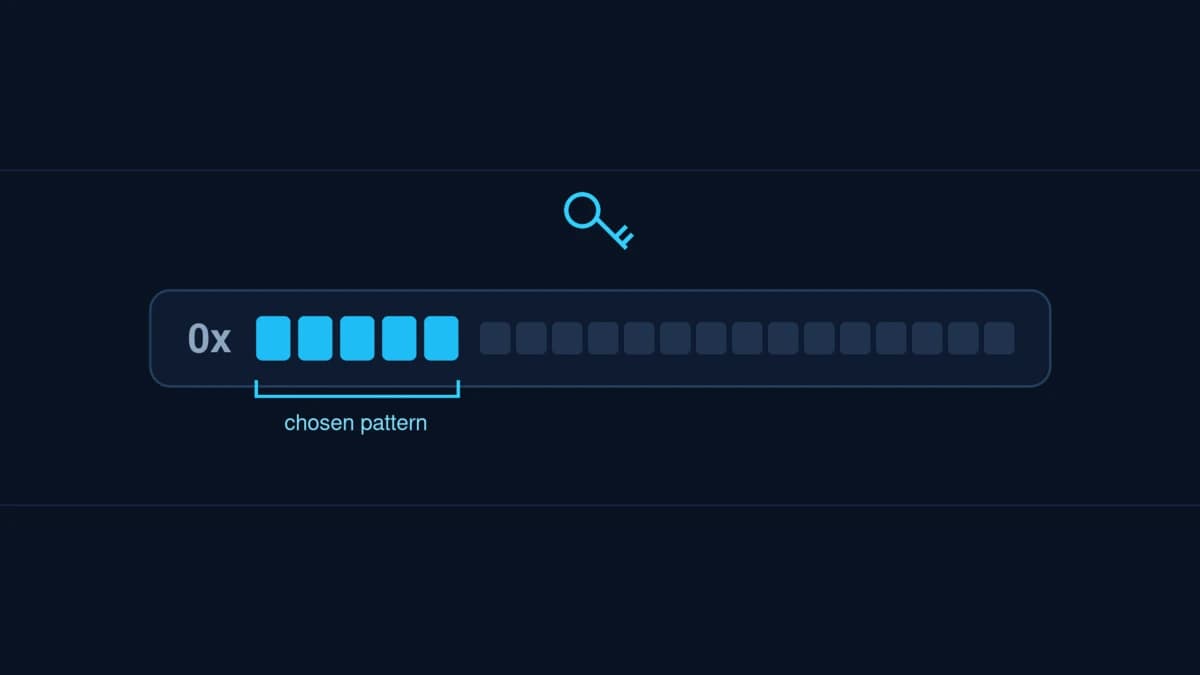
A vanity address is a normal crypto wallet address that has been generated to contain a specific, human-chosen pattern, usually at the start or the end. Think of an address that begins with a string of zeros, spells out a brand name in hex characters, or ends in a memorable sequence. Underneath, it is an ordinary address with a matching private key. The only difference is that someone searched for a keypair whose public address happened to match the pattern they wanted.
Crucially, a vanity address is not more powerful or more secure than any other address. It controls funds exactly the same way. The pattern is pure cosmetics.

How Vanity Addresses Are Made
You cannot simply pick the address you want. Addresses are derived from private keys through one-way cryptography, so the only way to get a specific pattern is to try enormous numbers of random keys until one produces an address that matches.
- Generate a random keypair. A tool creates a private key and derives its address.
- Check the pattern. If the address matches the target, keep it. If not, throw it away.
- Repeat, fast. Software repeats this millions or billions of times until it finds a match.
This is pure brute force. There is no clever shortcut, only raw computing power grinding through keypairs until one fits.
Why Pattern Length Matters
The longer or more specific the pattern, the exponentially harder it is to find. Matching one or two leading characters is instant. Matching five or six starts to take real time. Push toward eight, ten, or more specific characters and the search can take days, months, or become effectively impossible on normal hardware.
Each extra character you demand multiplies the work by roughly the size of the character set. A short prefix is cheap. A long custom word is astronomically expensive, which is exactly why most vanity addresses only pin down a few characters.
Why People Use Vanity Addresses
- Branding. Projects and businesses like a donation or treasury address that visibly starts with their name or ticker.
- Memorability. A recognisable prefix is easier to spot at a glance than pure randomness.
- Signalling. A clean, deliberate address can look more professional for a public-facing wallet.
The Safety Warning You Must Not Skip
This is the part that matters most, because vanity addresses have a dark history. The danger is not the address, it is the tool that makes it.
- Never use an online or untrusted generator. A website or app that generates a vanity address for you can simply keep the private key. If you fund that address, your money can be stolen at any time. Only ever use open-source tools you can inspect and run yourself, offline.
- Weak randomness has drained real wallets. A once-popular vanity tool used flawed key generation, which let attackers reverse-engineer private keys and steal large sums from addresses it had produced. If the randomness behind a key is predictable, the address is a time bomb regardless of how it looks.
- The pattern gives zero security. A pretty prefix does not make an address safer. Your safety comes entirely from the private key being generated securely and kept secret.
Vanity Addresses and Scams
There is a second trap. Because attackers can also generate vanity addresses, they create lookalikes that match the first and last few characters of an address you use, then try to trick you into copying theirs. This is the core of address poisoning, and it works precisely because people verify only the ends of an address. A matching prefix should never be treated as proof.
Always verify the full address, not just the vanity part, and lean on the checks that actually protect you, like the checksum built into the address and the habits in Address Poisoning Scams.
Key Takeaways
- A vanity address is a normal wallet address generated to contain a chosen pattern, usually a prefix or suffix.
- It is made by brute force, generating random keypairs until one matches, so longer patterns get exponentially harder.
- The pattern is cosmetic and gives no extra security whatsoever.
- Only ever generate one with an open-source, offline tool. Untrusted or online generators can steal your funds.
- Attackers use vanity lookalikes for address poisoning, so always verify the full address, never just the ends.
Vanity addresses are a fun bit of crypto culture, and for a public brand wallet they can genuinely add polish. Just keep the two rules front of mind: the pretty pattern buys you nothing in security, and the tool that makes it must be one you fully trust and run yourself. Get those right and a vanity address is harmless flair. Get them wrong and it is one of the easier ways to lose everything in the wallet.
This article is educational and is not financial advice. Only generate keys with trusted, open-source, offline tools and never share a private key.