
What Is Robinhood Social? Robinhood's Copy Trading Feature, Explained
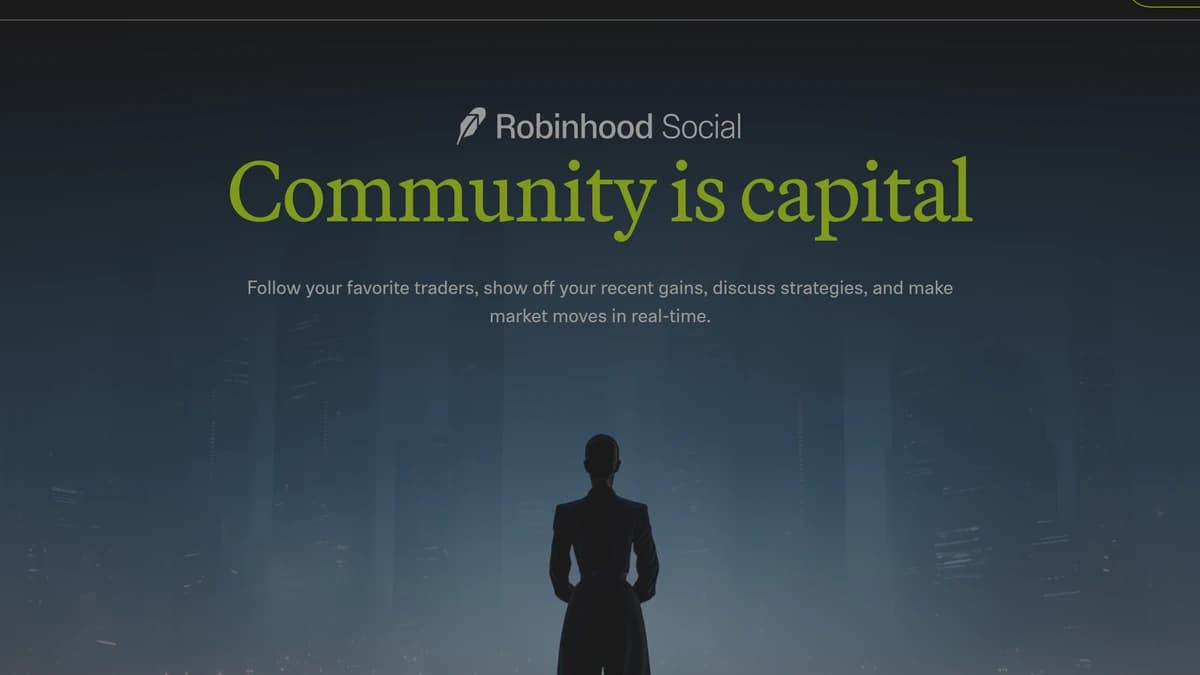
For years, Robinhood mocked copy trading as a gimmick. In 2026 it built its own version, and it is one of the most talked-about additions to a mainstream brokerage in a while. It is called Robinhood Social, it launched to a first group of users on March 18, 2026, and its tagline says the quiet part out loud: "Community is capital." Here is what it actually is, how it works, what makes it different from the copy-trading apps that came before it, and what to watch out for.
What Robinhood Social actually is
Robinhood Social is a feed built into the Robinhood app where you can follow other traders, see their real trades and positions, discuss the market, and replicate their moves. Think of it as a social network wrapped around a brokerage account: instead of just reading opinions, you can watch what people actually do with their money, in real time, and act on it. Robinhood describes it as the first place where you can do this across stocks, options, futures, crypto and prediction markets in one app.
The trust angle is the pitch. Every profile on Robinhood Social belongs to a real, KYC-verified person, not an anonymous handle. The idea is that you can see a trader's genuine track record before you decide to follow anything they do, which is Robinhood's answer to the anonymous, screenshot-faking "gurus" that plague crypto Twitter.
The one big catch: it is manual, not automatic
This is the detail everyone misses, and it matters. Unlike the European-style copy trading popularized by eToro, where you can flip a switch and have your account mirror someone else's trades automatically, Robinhood Social does not auto-copy. You can see exactly when and how a trader opens and closes a position, in real time, but you have to place the trade yourself. Robinhood is taking a deliberately slow, cautious approach here because automated copy trading sits in a grey area with US regulators. So "copy trading" on Robinhood really means "assisted manual copying": the information is served to you instantly, but the decision and the click are always yours.
How to use Robinhood Social
- Get access. Robinhood Social is rolling out to a limited group first and expanding through 2026. Check the Social tab in the Robinhood app, or Robinhood's Social page, to see if it is live for your account.
- Find and follow traders. Browse verified profiles, look at their real holdings and track record over time, and follow the ones whose approach you actually understand.
- Watch trades in real time. When someone you follow opens or closes a position, you see it confirmed live, including the timing and size.
- Replicate manually. If you want to mirror a move, you place the trade yourself. Nothing happens to your account automatically.
- Size it for your own risk. A trader with a large account can take positions you should not. Copy the idea, not the position size.
The crypto angle
For crypto traders this is the interesting part. Robinhood Social covers crypto alongside stocks and options, and it arrives while Robinhood is pushing hard into on-chain markets, including its own Robinhood Chain. Following a verified crypto trader and watching their entries and exits in real time is genuinely useful, but remember the golden rule of any copy trading: seeing someone's trade does not tell you their thesis, their time horizon, or their risk tolerance. The same principle we apply to memecoins applies here. Before you copy anyone into a token, read it on-chain yourself: check the liquidity, the holders and the safety flags with our Token Safety Checker.
How it compares to other copy trading
Copy trading is not new. Platforms like eToro, Bitget and Bybit have offered it for years, usually with full automation. What makes Robinhood Social different is the combination of KYC-verified profiles, manual-only copying, and multi-asset coverage in a single mainstream app that tens of millions of people already use. If you want fully automated mirroring today, the established copy-trading platforms still do that. If you want a verified, social, hands-on version tied to a broker you already have, that is the niche Robinhood is building.
The risks worth remembering
Robinhood Social lowers a few classic copy-trading risks and leaves others fully intact. Verified profiles make it harder to follow a fake track record, and manual copying means you cannot get silently drained by an automated setting. But the core risks do not go away: a verified trader is not a good trader, past performance is not a promise, and copying a position without understanding it is still gambling with extra steps. Access is also limited for now, and the regulatory picture around copy trading in the US is still evolving. Treat it as a research and idea-generation tool, not a shortcut to someone else's returns. None of this is financial advice.