
What is Bittensor (TAO)? Subnets and Validator Mining
Bittensor decentralizes artificial intelligence by creating a marketplace for compute. We break down the roles of subnets, miners, validators, and the TAO emission lifecycle.

DeFi and Protocols Writer
Boni is a crypto and DeFi writer at DEXTools News focused on analysing trends, protocols, and opportunities across decentralized finance. He covers lending, perpetual DEXs, yield, and tokenomics, explaining how protocols work and where the real risks and edges sit, with an emphasis on mechanics over speculation.
454 articles published

Bittensor decentralizes artificial intelligence by creating a marketplace for compute. We break down the roles of subnets, miners, validators, and the TAO emission lifecycle.

Merging decentralized networks with machine learning layers creates an open-source alternative stack to Big Tech. We break down GPU compute routing, tokenized data acquisition, and autonomous agent economies.

Parabolic crypto charts can hide devastating smart contract traps. We break down how honeypot tokens utilize 100% sell taxes and blacklists to lock up your funds, and how to spot them using automated simulators.

Guarding your private key cannot protect your capital if you voluntarily sign away your asset permissions. We break down the structural mechanics of ice phishing, malicious ERC-20 allowances, and gasless signature exploits.

Guarding your seed phrase is no longer enough to secure your Web3 assets. We break down how automated wallet drainers exploit off-chain signatures, CREATE2 contract address predictions, and EIP-7702 delegation flows.

Multiplying highly correlated stablecoin values via credit loops maximizes capital efficiency but magnifies micro-depeg risks. We break down recursive lending structures, safe leverage limits, and liquidation defenses.

Automating manual reward harvesting and re-depositing maximizes capital efficiency while minimizing gas fee drag. We break down the technical differences between Yearn V3, Beefy multi-chain optimization, and Sommelier algorithmic routing.

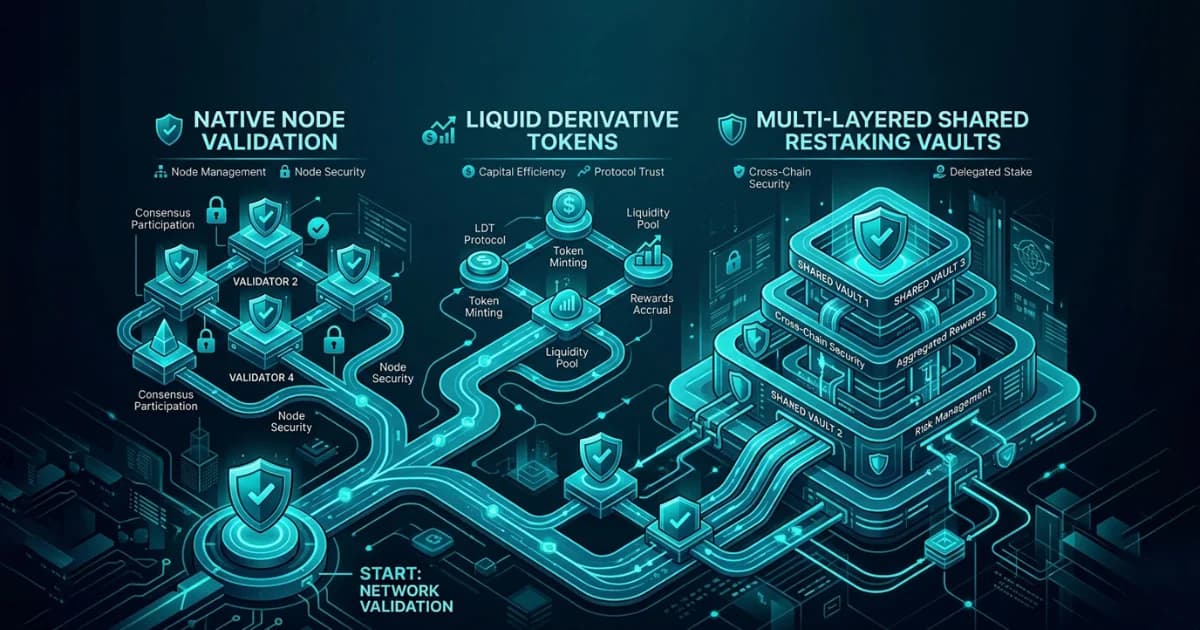
Choosing how to secure a blockchain network while deploying capital efficiently requires balancing risk and return. We analyze staking variables, smart contract risks, and structural decision tree pathways.

Prioritizing liveness over safety is the primary vulnerability for solo stakers. We break down the technical realities of double-signing faults, post-Pectra correlation penalties, and DVT mitigation tools.

Expanding shared security beyond single-chain assets optimizes capital efficiency. We break down Karak's multi-chain restaking vaults, DSS development kits, and K2 infrastructure.

Transitioning from monolithic restaking to permissionless universal trust layer frameworks minimizes network dependency. We break down Symbiotic's modular vaults, operator networks, and customizable resolver loops.

Extending Ethereum's economic security to protect external middleware networks maximizes capital efficiency but introduces unique validation risks. We break down EigenLayer restaking mechanics, AVS leases, and mainnet slashing rules.